The Air You Breathe is Your Most Critical Vulnerability
In any nuclear, biological, or chemical (NBC) event, the air becomes the primary vector of harm. Radioactive fallout particles, biological agents like anthrax spores, and chemical warfare agents like sarin or VX are all airborne threats. Without a properly designed NBC air filtration system, even the most heavily reinforced bunker is merely an expensive tomb.
NBC air filtration is the multi-stage air purification system that transforms contaminated outside air into breathable, safe air inside a sealed shelter. It is, without exaggeration, the single most important system in any protective shelter.
The Four Stages of NBC Filtration
Stage 1: Pre-Filter
The pre-filter is the first line of defense, capturing large particles, dust, and debris before they reach the more sensitive downstream filters. In a nuclear event, the pre-filter captures the largest radioactive particles and extends the life of the HEPA filter. Pre-filters are typically rated EU3-EU4 (G3-G4) and are designed to be easily replaceable. They capture particles larger than 10 microns and should be replaced every 3-6 months under normal conditions, or immediately after a contamination event.
Stage 2: HEPA H14 Filter
The HEPA (High Efficiency Particulate Air) filter is the workhorse of the NBC system. Rated H14, it removes 99.995% of all particles down to 0.3 microns in diameter. This captures radioactive dust and fallout particles (typically 1-10 microns), biological agents including anthrax spores (1-5 microns), bacteria (0.3-10 microns), and most viruses when attached to carrier particles. The H14 rating is critical — lower-rated HEPA filters (H13 or below) do not provide sufficient protection against the smallest radioactive particles. HEPA H14 filters typically last 2-5 years under normal conditions but should be replaced after any contamination event.
Stage 3: TEDA-Impregnated Activated Carbon Filter
While HEPA filters excel at capturing particles, they cannot remove gases or vapors. This is where the activated carbon filter comes in. Standard activated carbon adsorbs a wide range of chemical compounds through physical adsorption. However, for NBC protection, the carbon must be impregnated with TEDA (Triethylenediamine) — a chemical compound that specifically targets radioactive iodine-131.
Radioactive iodine-131 is one of the most dangerous byproducts of a nuclear detonation. It exists as a gas that passes through HEPA filters and standard carbon filters. Only TEDA-impregnated carbon can capture it effectively. The TEDA carbon filter also adsorbs chemical warfare agents including nerve agents (sarin, VX, tabun), blister agents (mustard gas), and blood agents (hydrogen cyanide). Filter lifespan depends on contamination levels but is typically 5-10 years under sealed storage conditions.
Stage 4: Positive Pressure Overpressure System
The final stage is not a filter but a pressure management system. The NBC blower pushes filtered air into the shelter at a rate that maintains internal air pressure slightly above ambient — typically 0.3 mbar (30 Pa) above outside pressure. This positive pressure differential ensures that any micro-gaps in the shelter's seal result in air flowing outward (clean air escaping) rather than inward (contaminated air entering). The overpressure system is what makes the entire NBC system work as a sealed environment. Without it, contaminated air could seep in through door seals, cable penetrations, or micro-cracks in the concrete.
Sizing Your NBC System
NBC systems are sized based on the number of occupants and the shelter volume. The minimum fresh air requirement is typically 6-8 cubic meters per person per hour in normal mode and 0.5-1 cubic meter per person per hour in emergency (recirculation) mode. A shelter designed for 10 occupants would require an NBC system capable of processing 60-80 cubic meters of air per hour. Systems should include redundancy — at minimum, a backup blower and a complete set of replacement filters stored within the shelter.
Maintenance and Testing
An NBC system is only as good as its maintenance. Pre-filters should be inspected quarterly and replaced every 6-12 months. HEPA H14 filters should be pressure-tested annually and replaced every 3-5 years. TEDA carbon filters should be tested for breakthrough every 2 years and replaced every 5-10 years. The overpressure system should be tested monthly with a manometer reading. All seals and gaskets should be inspected annually. A complete system test (full NBC mode with all filters and overpressure) should be conducted at least annually.
What We Install at Mallorca Bunkers
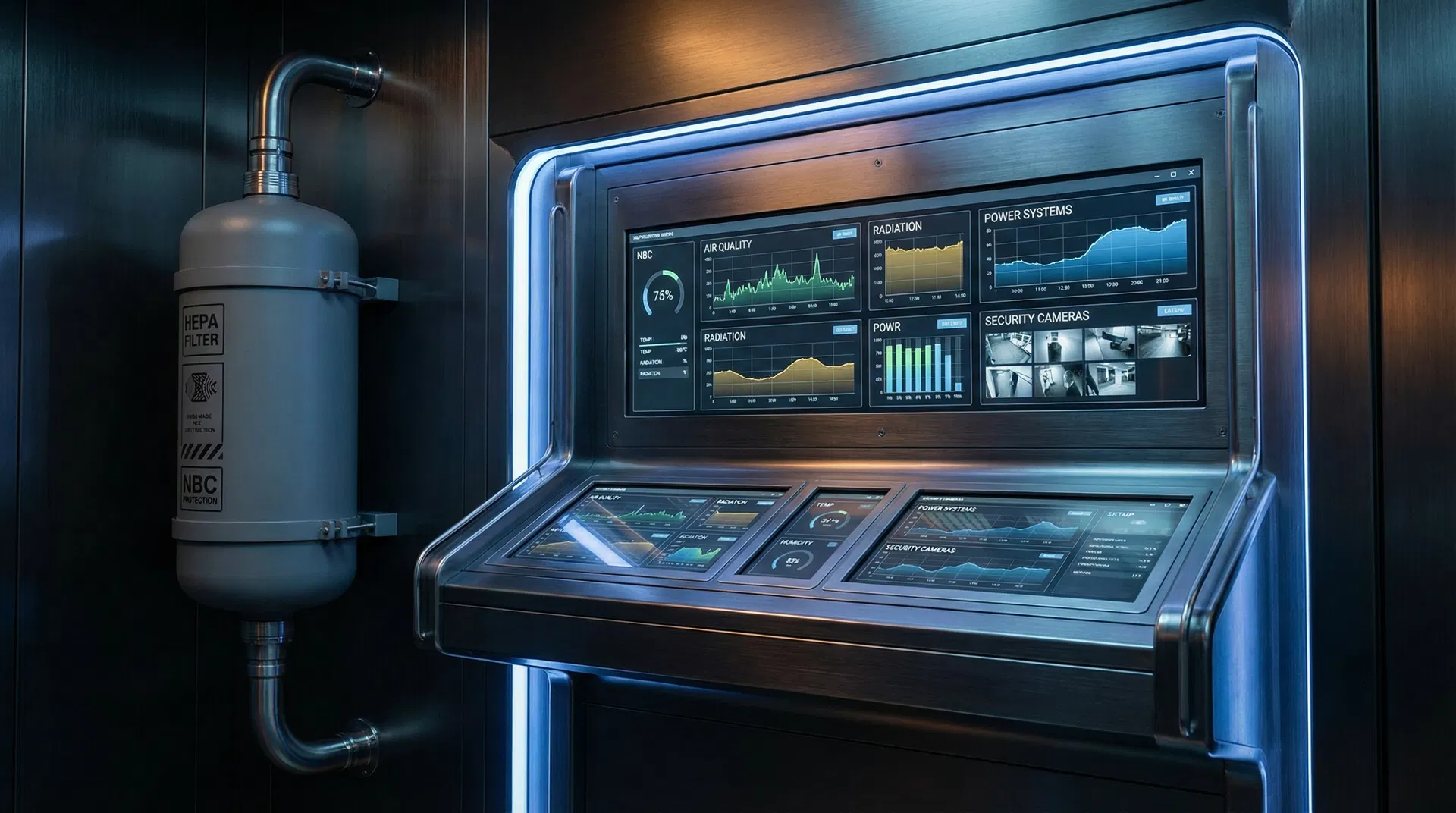
At Mallorca Bunkers, we install Swiss-certified NBC systems from Andair and Luwa — the same manufacturers that supply Switzerland's federal shelter program. Every system includes redundant blowers, a complete spare filter set stored in the shelter, digital monitoring with remote alerts, and annual maintenance contracts. Our systems exceed Swiss PF-1,000 requirements and are designed for minimum 72-hour continuous operation in full NBC mode.